St. George's Chapel, Windsor. England.
A touchstone for heraldry.
| "All
were clad in gowns of russet...wearing the...garters on their right
legs, and wearing mantels of blue with escutcheons of St. George...in
honour of the holy Martyr, to whom they specially dedicated their
noble fraternity [they called] their company that of St. George of
the Garter"4 |
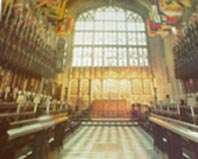
The Order of the Garter is a secular company, a reincarnation
of knights of the "Round-Table",
dedicated to St. George the dragon slayer of the late 200's in the
Byzantian Empire and subsequently adopted by the crusaders. Others
see St. George as being part of Edward III's propaganda machine, St.
George replacing Edward the Confessor as the Patron Saint of England
and St. Michael the dragon slayer. Edward III successfully established
St.George who became to be reguarded as the patron of knights all over
Christendom.
The first 'Round-Table' gathering was held in 1344 at
Windsor. Between October 1347 and the end of 1348, following
the incredible successes in France, tournaments were held including
those at Windsor. Either on the 10th or the 24th of June 1348 the
first Garter Ceremony was held in St. George's Chapel.. The idea for
the Garter came to Edward III at the conclusion to a Windsor tournament
in 1344.3
The opportunity arose from a mishap at a ball probably
held at Calais after the fall of that city to Edward's siege in 1347.
The concept embraced the establishment of a new Camelot around
a table of Edward's closest knights.3 See St. George as
depicted in the 1300's
On the 10th August 1348, whilst the plague swept through England,
the founder knights filed 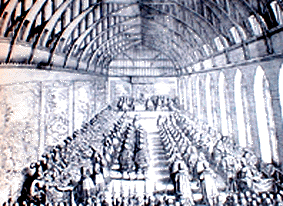 in pairs into St. George's Chapel for their first investiture.
The lines parted thence to seat themselves behind either the king
or the Black Prince. They faced each other across the chapel like the
opposing tournament teams they were meant to represent.
in pairs into St. George's Chapel for their first investiture.
The lines parted thence to seat themselves behind either the king
or the Black Prince. They faced each other across the chapel like the
opposing tournament teams they were meant to represent.
The previous 15 years of Edward III's reign had been
so militarily successful that it was seen that only with God's help
such achievements could have been made [Halidon, Neville's Cross,
Crecy, Calais,
Potiers] but essentially the investiture remained a non-religious
occasion.
The formation of the Garter Knights who emulated the fabled
knights of King Arthur was in part Edward III's way of bringing together
the descendants of the warring parties of his father's less than successful
reign. By claiming the high ground in an idealogical chivalric code,
Edward managed to develop the courtly and knightly behaviour which became
a part of a gentlemen's behaviour at court which gradually spread,
by imitative fashion, to the general population. Prior to this, knights
had lived principally by the sword under a feudal sytem which promoted
itself in a never ending bout of revenge between knightly families and between
the nobles and the kings. A certain kind of behaviour was expected of the
'new age' knight, an ideology based upon a group of knights in a medieval
romance, Morte D' Arthur.
In the 1190's Hugh De Morville of Cumberland
& Westmorland is said to have taken the local story of Arthur
in written form to the Continent when he replaced King Richard
of England as a hostage of the Austrians. This work influenced Ulrich
Von Zatzighoven who in turn influenced Chretien De
Troyes who wrote Morte D' Arthur which reintroduced
Arthur into Britain as a medieval French romance.
The
Round Table knights
As named on the Winchester
Round Table, the highest order of chivalry in the Court of King Arthur
|
Winchester Round Table
knights
|
Morte D' Arthur
|
Kyng Arthur
Sir Galahallt [Galahad]
Sir Launcelot Deu lake
Sir Gauen [Gawain]
Sir Perceval [Percyvale]
Sir Lyonell [Lionell]
Sir Trystram De Llyens [Lyons]
Sir Garethe [Gareth]
Sir Bedivere [Bedwere]
Sir Blubrys [Bleoberis]
Sir La Cotemale Tayle
Sir Lucane [Lucan]
Sir Plomydes [Palomedes]
Sir Lamorak
Sir Born de Ganyis [Bors De Ganys]
Sir Safer
Sir Pelleus [Pelleas]
Sir Kay
Sir Ector de Maris [Ector de Marys]
Sir Dagonet
Sir Degore
Sir Brumear [Brunor le Noir] Sir Lybyus Dysconyus [Le Bel Desconneu]
Sir Alynore [Le Bel Desconneu]
Sir Mordrede [Mordred]
|
King
Arthur
Sir Galahad
Sir Lancelot du Lac
Sir Gawain
Sir Percivale
Sir Lionel
Sir Tristram de Lyones
Sir Gareth
Sir Bedivere
Sir Bleoberis
La Cote Male Taile
Sir Lucan
Sir Palomides
Sir Lamorak
Sir Bors de Ganis
Sir Safir
Sir Pelleas
Sir Kay
Sir Ector de Maris
Sir Dagonet
Sir Tegyr
Sir Brunor le Noir
Le Bel Desconneu
Sir Alymere
Sir Mordred
|
 |
| A copy of the
Winchester table made for King Edward I that was repainted during Henry
VIII's reign |
|
"The Fraternity of St George"
The
Founder Knights 1348
|
1. Edward III
2. Prince Edward Plantagenet, Prince of Wales [The Black
Prince], of Woodstock
3. Henry Plantagenet Duke of Lancaster
4. William Montacute [ Montague], earl of Salisbury*
5. Ralph de Stafford, Eearl of Stafford
6. Thomas de Beauchamp, 3rd earl of Warwick [Thomas
de Beauchamp]
7. Sir James Audeley [Audley]
8. Walter Balieley/Balle [Walter
Paveley?]
[Pareley+]
9. Sir John de Beauchamp
10. Bedivere
11. de la Boleye
12. Sir Batholemew Burghersh of Burwash
13. Sir John Chandos,
14. Sir Hugh Courtenay
15. Sir Jean de Grailly, a Gascon
16. Sir John de Grey [of Codnor]
17. Henry Plantagenet of Grosmont, 1st Duke of Lancaster,
earl of Derby
18. Oties/Otes/Otis/Otho/Eton Holland, brother of Thomas
19. Thomas Holland, 1st earl of Kent
20. Santal Labrychant [Sanchet D'Abrichecourt, Sanchio d'Ambeticourt
? of Sawbridgeworth, Herts.]9
21. Neele Loring
22. John de Lysle [Lisle], 1st Baron Lisle de Rougemonte, Lord
of Harewood,
Yorkshire.5
23. Roger Mortimer, earl of March
24. Percival
25. Sir Miles/Myles Stapleton [of Yorkshire]
26. Trotfleur
*Note- William de Montague [Montacute] was the
last surviving member of the founding knights]
+ According to B. Holland, The Hollands of Lancashire.
The Queen and Ladies were made "Dames of the Fraternity".
The Knights were paralleled by 26 "impoverished warriors" |
According to Camden:
1. Edward III
2. Prince Edward Plantagenet, Prince of
Wales [The Black Prince]
3. Henry Plantagenet Duke of Lancaster
4. Thomas de Beauchamp, 3rd earl of
Warwick
5. Ralph de Stafford, 1st earl of Stafford
6. William Montacute, earl of Salisbury
7. Roger Mortimer, earl of March
8. Jean de Grailly, Capdall de Buche
[Piers de Greilly, Capital de Buch]+
9. Sir John de Lysle [L'Isle], Baron Lisle
10. Sir Batholemew Burghwash/Burwash
11. John de Beauchamp
12. Sir John de Mohun [of Dunster]
13. Sir Hugh Courtenay
14. Thomas Holland, earl of Kent
15. Sir John de Grey
16. Sir Robert [Richard+]
FitzSimon
17. Sir Miles Stapleton
18. Sir Thomas Walle [Wale+]
19. Sir Hugh Writhealey [Wrottesley+]
20. Sir Niel [Nele+] Loring
21. Sir John Chandos
22. Sir James Audley
23. Sir Otho Holland, brother of Thomas
24. Sir Henry Ewe
25. Sir Zanchet Dabridgecourt
26. Sir William Paynell/Paganell
Those names shown in a lighter colour are
differences between the two lists. All of these knights and the king appear
in William Bruges Garter Book. William was the first Garter King of
Arms.
|
They filed into St. George's Chapel, Windsor Castle on the 10th August
1348 in pairs, the lines parting to seat themselves behind either
the king or the Black Prince. They faced each other across the chapel
like the opposing tournament teams they represented.
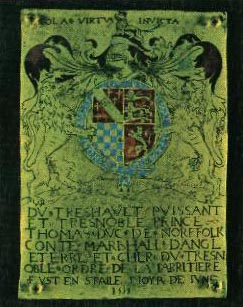 When each Garter Knight was created they were given
a brass and enamel stall plate which was affixed to their stall
in the chapel. They entered the chapel in 13 pairs which is probably
the number of men in a jousting team.
When each Garter Knight was created they were given
a brass and enamel stall plate which was affixed to their stall
in the chapel. They entered the chapel in 13 pairs which is probably
the number of men in a jousting team.
When a knight companion was created, besides the stall
plate, a crested helm and banner were displayed there. On the Garter
knight's death the banner and helm were taken away but the stall plate
remained.
A knight who was attainted was degraded from the Order.
For example the 4th Duke of Norfolk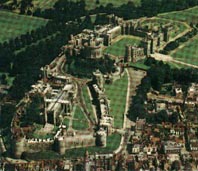 who entered the Order in 1559 tried to dethrone
Elizabeth I, for this treasonable act he was attainted and executed.
The stall plate was removed in 1572 and not replaced until 1955. [an
earlier Duke of Norfolk's daughter had married the 6th earl Warenne and
so quartered the Warenne arms on his own].
who entered the Order in 1559 tried to dethrone
Elizabeth I, for this treasonable act he was attainted and executed.
The stall plate was removed in 1572 and not replaced until 1955. [an
earlier Duke of Norfolk's daughter had married the 6th earl Warenne and
so quartered the Warenne arms on his own].
Today, the Trooping of the Colour and the investiture of The Knights of
the Garter are performed on the Queen's Official birthday, the second
Saturday in June. This was chosen as Queen Elizabeth II's birthday
in April falls at a time of unreliable weather.
Winston Churchill, Knight of the Garter.
We have probably heard
the story about Sir Winston who had been over- imbibing, when he
was drawn to remark rather loudly "God madam you are ugly", to which
she replied, "Sir, you are drunk!" to which Winnie retorted
"In the morning madam, I will be sober but dear lady you will
still be ugly!"
At the time Winston had just
lost power as head of the Conservative government, he was offered
"The Garter" to which he replied "Why should I accept the Order of The
Garter when I have just been given the Order of the Boot!"
On
an occasion following his investiture Winston, stood up at the assembled
royal dinner and proceeded to withdraw £1500 in
cash from his pocket. He theatrically counted out the money, saying,
this cloak had cost so much and that hat so much and so on. He concluded
that The Order of the Royal Garter should be renamed "The Order of the
Royal Fleece".
|
After 1347, following Crecy, Edward founded the
"Order of the Knights of the Blue Garter" consisting of himself and 26 of
his most renowned companions. The Order was housed in the original St. George's
Chapel part of Windsor Castle. St. George's Chapel was rebuilt in 1475 under
Edward IV. One of the earliest burials here in the renewed chapel was Henry
Holland , 3rd Duke of Exeter who was married to Anne, Edward IV's sister. Holland
was the only legitimate male descendant of John of Gaunt and the House of
Lancaster until he was found dead in the English Channel in September
1475. His burial at the chapel was despite the fact that in his
later years he had divorced Anne and joined the Yorkists.
 |
|
Garter Stall Plate of Sir Thomas Beauchamp |
King Edward III created the Order of
The Garter for his bravest knights. The Order won its name and
motto when according to Froissart the 'Countess of Salisbury', his possible
mistress, dropped a garter at the ball about
1347-1348. He boldly picked it up and fastened it to his own leg and
to counter the sniggers, and declared: "Honi Soit Qui Mal Y Pense"
loosely translated to "Shame on him who thinks evil of it".
Indicating the humour of Edward III, the
Order of the Blue Garter was born and the motto remains on
the coat of Arms of the Royal Family to this day. This act by the king
is speculated to be a counter to the perception by the assembled guests
that the king was having an affair with 'the Countess of Salisbury'
such that he made light of it by turning the embarrassment around
and making it an honour for the Court was
aware of the king's love for the countess3 Personally I think, Edward being the paramount of
chivalry [at least popularly] was trying to salvage a ladies honour. Edward III is supposed to have raped and battered the
"Countess of Salisbury", perhaps at Nottingham. But this was possibly
a piece of French propaganda from the Hainault chronicler Jean le Bel written in an attempt to cast a sleight upon the King of England, for
le Bel's narrative is full of errors when compared other sources.
The assembled guests no doubt relished the symbolic
embarrasment of the slipped garter. The Regent thereafter had to kneel
and affix the Garter to the honoured knight's leg at the Garter ceremony
in St. George's Chapel, Windsor Castle.
Froissart says of the alleged affair:
"You have heard me speak above of Edward's
love for the countess of
Salisbury. The chronicle of Jean le Be1 speaks of this love less
properly
than I must, for, please God, it would never enter my head to incriminate
the king of England and the countess of Salisbury with such a vile
accusation. If respectable men ask why I mention that love, they
should
know that Jean le Be1 relates in his chronicle that the English
king raped
the countess of Salisbury. Now, I declare that I know England well,
where I have lived for long periods mainly at the royal court and
also with
the great lords of that country. And I have never heard tell of
this rape
although I have asked people about it who must have known if it
had
ever happened. Moreover, I cannot believe and it is incredible
that so
great and valiant a man as the king of England would have allowed
himself to dishonour one of the most noble ladies of his realm
and one
of his knights* who had served him so loyally all his life."
*This was William de Monte Acuto [Montacute]
1st earl of Salisbury who had helped King Edward enter Nottingham Castle
by a secret passageway in order to capture Rogeri de Mortuo Mari [Mortimer]
in 1330.
|
The Purpose of the Order
of the Garter4
"A fellowship, a college
of knights to represent how they ought to be united in all chaunces
and various Turns of Fortune; co-partners in both peace and war, assistant
to one another in all serious and dangerous exploits: and thro' the
whole course of their lives to shew fidelity and friendliness to one
another"
In essence it was Edward III's design to help secure loyalty
from his leading knights after the shambles of Edward II's reign. Grandiose
titles, flambouyant pageantry, an impressive design still in effective use
today.
|
The Italian Polydore Vergil's twenty-six volumes
of Anglicae Historicae Libri, written over a hundred and fifty
years later, first claimed that it was Joan of Kent who was the 'Countess
of Salisbury' and that she prompted the garter incident. Later researchers
suggest that it was Joan's mother-in-law, Katherine Grandisson who was
widowed by 1344 after William her husband and the first earl died.
UPDATE: A thorough search of the C.P.R. indicates that Joan was never
referred to as the 'Countess of Salisbury'! 'Joan of Kent' does
not appear, as we would expect her salutation to be, as 'Joan, wife of
William de Monte Acuto, earl of Salisbury'. The reason for this is that
the man she married in 1341, who became William Montacute 2nd earl of Salisbury,
did not come of age until 1349. In the C.P.R. he does not appear as the
earl of Salisbury until 1350. Gransden states that he did not receive livery
of his lands until 13497. Before 1350 he is merely referred to
as the 'heir of William de Monte Acuto earl of Salisbury' and the ward of
Edward III. Similarly Joan is referred to as the 'wife of William
de Monte Acuto, son on William de Monte Acuto, earl of Salisbury'. The Pope
granted a marriage annulment to Joan and William in 1349 when they were
both aged twenty / twenty-one which seems to have coincided with William becoming
the 2nd earl of Salisbury.
Froissart's successors mistakenly used the title 'Countess of Salisbury'
at the Garter Ball to mean Joan, and thus the Garter incident seems
to have originated with the widow of the first earl of Salisbury's wife,
Katherine Grandisson not Joan of Kent. Katherine's husband, the
first earl, died in 1344 and Katherine was thus widowed from the age of
about 40 [1344] to age 45 [d. 1349] which encompasses the time of a possible
ball held after the Siege of Calais [which lasted from Sept. 1346 to August
1347] or shortly thereafter, for the Garter ceremony was inaugurated between
October 1347 and the end of 1348.
Joan of Kent about 1352 was styled 'Countess of
Kent', after her brother John died in that year. Like Katherine she may have
been wooed but unlike Katherine, not won by the king, for she was in love
with the earl of Salisbury's steward, Thomas Holland, to whom she had secretly
been promised and then married in the sight of witnesses at age twelve
[1340]. Either to be closer to her lover or for fear that Thomas would
be executed when he returned from France, Joan did not divulge her first
marriage at her second marriage to William II Montacute in 1341. Eventually,
Thomas Holland returned to England and after beseeching King Edward and
the Pope he received an annulment, through a Papal Bull, of Joan's marriage
to William Montacute. Thomas and Joan had four children but after Thomas'
death in Normandy in 1360, Joan clandestinely married Prince Edward the 'Black
Prince'.
Thus successive chroniclers have conflated the title 'Countess of
Salisbury' with Joan of Kent, Katherine de Montacute [Grandisson]
ans even Alys [Alice] Montacute, wife of Edward Montacute the brother
of the1st earl. We now need to make a sharp distinction between Joan of
Kent and Katherine Grandisson who after her husband's death was the dowager
countess of Salisbury. Katherine was the countess whom King Edward was
infatuated with [whether the rape occurred or not] and she was the same
person who lost the garter. Joan of Kent was not the countess of Salisbury
|
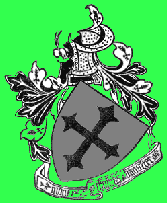
| A drawing of a garter or stall-plate
for Sir Thomas Banastre showing argent a cross patonce sable.
|

|
| St George's Day is celebrated
on the 23rd of April each year. At this time St. George's flag is
flown from every Christian Church in England. However, most people are not
aware that before almost mythical St. George became the patron saint
of England, the English king, Edward the Confessor had been its
principal patron.
|
 Edward III's friend
Sir Thomas de Beauchamp 3rd earl of Warwick was a knight
of the Garter, a friend to Edward III and a guardian of the boy king,
Richard II. The Arms of the earl of Warwick included an heraldic bear
which is incorporated today into the Arms of the town of Warwick.
A brass of Sir Thomas Beauchamp and his wife, Margaret appears in
St. Mary's Church, Warwick dated to 1406.
 HOME
PREVIOUS
- EDWARD III HOME
PREVIOUS
- EDWARD III
Sources:
1. Treasures of Britain, 1970.
2. Bedingfield H., Heraldry.
3. Lee Christopher, This Sceptered
Isle, Penguin/BBC Books, 1997.
4. Le Baker, Geoffrey, Chronicon.
5. Jones, John. The History and Antiquities of Harwood,
1859, p.37. The remains of Rougemont Castle lie N.W. of the present
Harewood House.
6. Calendar of Patent Rolls for the reign of Edward III.
7. Gransden, Antonia.The alleged rape by Edward III of the
countess of Salisbury". English Historical Review 87, 1972.
8. Speed, John. TheCounties of Britain. Pavilion Books, 1995.
9. Sawbridgeworth also Sabrichesworth, Sabrichesworthe, Sabrigcheworth, Herts.
Link : Artorius-
Leader of the Roman Britons.
Text copyright © Tim Midgley March 2001, revised
August 2023.
|
