| The name Montague originated in England as Montagud in 1086
[D.B.] later Montacute or Montague meaning 'pointed hill' from Old French
Mont+aigu. The Montagues were residents of Old Sarum, Wiltshire but the
name appears to have migrated from Somerset.
It was at Old Sarum that William I of England established his
palace and early Norman stronghold. Much of William's early directives and
planning occurred here after the initial invasion. In 1086, the year of
Domesday, every landholder, great and small was made to swear allegiance
in the Oath of Salisbury to William I at Old Sarum.
One Montague engineered the overthrow of Queen Isabella and
Roger de Mortimer at Nottingham whilst another may have written early Robin
Hood ballads in the latter part of Edward III's [essentially controlled
by John of Gaunt]
and Richard II's Courts.
William Longespee was Earl Salisbury d.1226. William's Arms were
Azure, six lions rampant Or. [in Salisbury Cathedral]. William was the
bastard grandson of Geoffrey, Count of Anjou d.1151. Geoffrey's arms found in
Le Mans Cathedral were also Azure, six lions rampant Or. This is the first
recognised case of heraldic arms being carried in the lineage. Geoffrey's
Arms were granted by his father-in-law, Henry I of England.
Another notable earl of Salisbury was Thomas Earl of Lancaster
who lost the title following his defeat at Boroughbridge and execution in 1322 at Pontefract Castle. From Thomas the earldom migrated to William de Grandis(s)on
of Burgundy who had one child, Alice [Alys]
The arms of Montague [of Sandwich, one of the
Cinque ports, the earl of Sandwich was a Montague of the 1700's who favoured
the fast food of the same name] are:
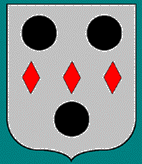
"Argent, three fusils conjoined in fess Gules within a bordure
sable"3.
Sir John Montague [1389] had wings within a crown as the crest4.
William Montague [Montacute] b. 1301
became, under Edward III, the 1st earl of Salisbury [ 6th earl of
Salisbury] in 1337. This resulted from his arranged marriage
to Edward III's ward, the young Madame Alys, countess of
Salisbury.
William was born 1301 or 1304 and died 1344. In 1322 he received
Lundy Isle from Edward III. According to the chronicler Geoffrey le Baker,
William was one of Edward III's closest friends and allies, indeed he
was the leader of Edward's companions who broke into Queen Isabella
& Roger de Mortimer's chambers at Nottingham Castle in 1330.
He swore to protect Edward III during the early years of his
reign when Edward was still a boy under the control of Queen Isabella
and her lover, Roger Mortimer.
1325- he was knighted and married the young Alys Grandisson
daughter of the 5th earl of Salisbury.
Alys and Joan confused
It was said that the "Countess of Salisbury" was enamoured of a steward
of the Earl of Salisbury so she married the earl to be close
to her sweetheart but both men died. This could have been Alys rather than
Joan "Fair maid of Kent" for William Montacute 2nd Earl of Salisbury who
she married, died in 1397 and she in 1385, whereas William Montague,1st Earl
Salisbury, died in 1344 unexpectedly from bruising after a Windsor joust.
William 1st earl died before Alys's death in 1350.
However another story relates that the steward previously mentioned
was none other than Thomas de Holland, appointed by Edward III to the Earl
of Salisbury's household, whom Joan had been secretly married to before
her marriage to William Montague 2nd earl Salisbury.
By the time of the Ball at Calais, and the famous Garter incident, Alys
was 2 years from death aged 55 years whereas Joan, by all accounts a very
beautiful woman, was only 20 years old.
Place the story next to 'fact' and it appears that this chronology has
better cohesion if Alys is the "Countess of Salisbury" in the Wark Castle incident in 1340 and Joan could have been the
"Countess of Salisbury" at the infamous Garter Ball. |
1327- William accompanied the young Edward III under Isabella
and Mortimer to Scotland, and later in 1329 to France.
1328 October- A Parliament was convened at Salisbury where
Roger Mortimer, Queen Isabella's lover, was given the title Earl of March.
October 1330- William assisted in Roger Mortimer's arrest in a coup at Nottingham
Castle and as a result was rewarded with some of Mortimer's Welsh Marcher
lands.
1331- disguised as merchants he and Edward III secretly visited
France.
William was present at the siege of Berwick and the Battle of Halidon Hill
in 1333.
1335- With the earl of Arundel in command of the army in Scotland.
1335- unsuccessful siege of Dunbar.
1337- made earl of Salisbury.
Titled 1st earl and 7th earl because he gained the title
following Thomas Plantagenet's treasonable act of making battle againt
Edward II in1322.
The Scots under Black Agnes held Dunbar castle against William
. In the same year [1337] made Admiral of the Fleet.
1338- In June 1338 William withdrew his forces from Dunbar,
he was recalled in readiness for the French campaign. He was made Marshal
of England.
1340- he served in Flanders and was taken prisoner to Paris.
 That Famous Garter
Whilst William her husband was absent,
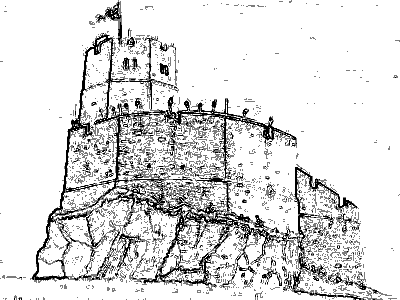
his wife Madame Alys also spelled Alice alias Catherine/Katherine was defending Wark Castle [near Berwick] with her husband's brother, Edward
de Montacute. The castle was placed under siege by David II's plunderers
who were increasing in numbers as word spread. As was common in these times
with the knight absent the Lady of the castle, in this case the countess of Salisbury had to defend this small castle
with only a constable, a few knights and 40 archers and servants. The siege
was raised by Edward III himself according to Froissart who describes the
encounter in great detail.
Jean Froissart
Born abt. 1337 died 1410? lived in England from 1360 to 1366. He was
a clerk to Queen Phillipa in 1362. Froissart depended heavily on the works
of the Frenchman Jean le Bel. In 1365 he visited the court of King David
of Scotland.
In 1366 he accompanied Edward III and the Black Prince to Gascony.
In 1383 he became a canon in Hainaut and revisited England in 1395 when
he met Richard II.
Froissart wrote Chroniques in French recording events from 1327-1400
which may be inaccurate in parts.
|
It would appear Edward III was captured by The Countess of Salisbury's
beauty and he made ministrations towards her which she rejected.
It is at this point that gossip led to stories that the Countess
of Salisbury had been abused. Edward is supposed to have raped and battered
the "Countess of Salisbury", whilst her husband was in France.
If not William's wife then probably Alice, the wife of Edward
Montague, younger brother of the Earl of Salisbury who were both present
at Wark Castle. One wonders why, if it did happen, that this would have
occurred, given the earl was Edward's best friend and a former guardian.
Edward led the charge in courtly chivalry, albeit a bloody time he had on
the battlefield. Again as with Alice Perrers there may have been an
attempt by the French Chronicler Jean le Bel to besmirch Edward's achievements.
There are inconsistencies in the stories about the "Countess
of Salisbury" as noted above. Note also the confusion of another Edward
[Montacute], William's brother being present at Wark Castle who also had
a wife named Alice! So presumably there were two Edwards and two Alices in
the one small castle.
Some have aligned the "Countess of Salisbury" with Joan "The Fair Maid of Kent" who married bigamously William
Montague the 2nd earl of Salisbury but this seems unlikely as the marriage
was immediately annulled in 1349 as she was already secretly betrothed to
Thomas Holland [Earl of Kent].
We also have a record of, Joan Plantagenet ["Fair Maid of Kent"
], Edward [later III] and William Montacute [later 2nd earl of Salisbury]
having lived at Salisbury Castle [Old Sarum] as wards
of the 1st earl Salisbury and Catherine [Alys] de Montacute.
Joan had originally been imprisoned in Salisbury Castle by
Mortimer & Isabelle after they had Joan's father a previous
Earl of Kent, executed.
Later, Joan married The "Black Prince" at the age of 33 after
her legitimate husband, Thomas de Holland died the previous year in 1360.
This marriage led to two children, the eldest of whom was Richard II who
ascended the English throne in 1377.
William 1st earl Salisbury was released
from Paris in 1340 and went on to win the Isle of Man from the Scots and
was crowned its king in 1341 which he held until his death in 1344. He
died from injuries sustained at a joust at Windsor.
See The
Winning of The Isle of Manne by The Noble Earle of Salisburie8
William Montacute b. 1328, d. 1397,
2nd earl of Salisbury [7th earl of Salisbury]. one of the original founding
knights of the Order of the Garter, at Crecy, Potiers; Admiral of the Western
Fleet.
In 1348, Edward III invited both the Earl of Salisbury [this
would have to be the 2nd earl as the 1st had died in 1344], William Montague
and his countess [Joan was 20 years old and married the earl bigamously
the following year] to a dance, this was probably at Calais rather
than Windsor,or even as some suggest, Wark Castle; for Edward was in France.
It was at this dance that the famous garter
fell from the "Countess of Salisbury's" leg. It was this mishap on the dance
floor which led to the Order of the Garter.
The second earl was contracted to marry Joan ["The Fair Maid
"] of Kent but the marriage was annulled immediately in 1349. Joan was
much admired for her beauty and following her legal return to Thomas de
Holland who died in 1360, she wed her 3rd husband the famed Edward Plantagenet,
"The Black Prince", Joan's second cousin in 1361.
Joan, William Montague [b.1328] and Prince Edward [later III]
grew up together in Salisbury Castle or "Old Sarum" [originally William
the Conqueror's fortress] under the care of William 1st earl Salisbury and
Catherine [Alys] Montague.
Old Sarum
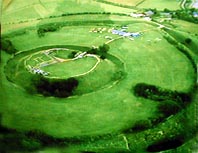
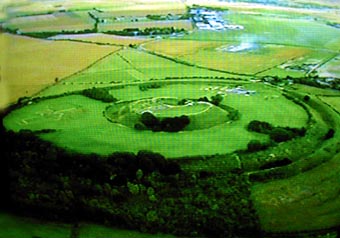 Here William I of England had a castle with motte and bailey built.
Alongside, a palace was constructed. The whole lay within a circular Iron
Age univallate hill fort of some 15 acres. Here a town grew up and a cathedral
was built. Old Sarum cathedral moved to the new site of Salisbury in the
early 1200's. The building was started in 1220 and completed about 1280.
The spire was added in 1334 by Edward III, it is the tallest church spire
in England.With the migration of the cathedral away from the fortress the
people followed, so that from Edward II's time the old site began to decline.
Here William I of England had a castle with motte and bailey built.
Alongside, a palace was constructed. The whole lay within a circular Iron
Age univallate hill fort of some 15 acres. Here a town grew up and a cathedral
was built. Old Sarum cathedral moved to the new site of Salisbury in the
early 1200's. The building was started in 1220 and completed about 1280.
The spire was added in 1334 by Edward III, it is the tallest church spire
in England.With the migration of the cathedral away from the fortress the
people followed, so that from Edward II's time the old site began to decline.
Previously Old Sarum had been the site of the Roman Sorviodunum which
lay at the crossing of Roman roads and later Searoburg in the Dark
Ages.
The castle was controlled by successive Earl's of Salisbury, the Montagues. 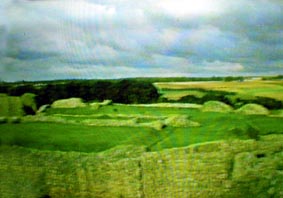
Joan Plantagenet,"Fair Maid of Kent", Edward [later III] and William
Montacute [later 2nd earl of Salisbury] lived at Salisbury Castle
[Old Sarum] as wards of the 1st earl Salisbury and Catherine
[Alys] de Montacute. Roger Mortimer had Joan of Kent imprisoned here when
she was a child after her father was executed whilst Edward [later III]
her brother, was still under the control of his mother Queen Isabella and
Mortimer. The Earl of Kent had been tricked into sending a message to Corfe castle in
Dorset where Isabella and Mortimer had falsely suggested that Edward I was
stll alive and well there. The letter proved his 'treachery' to Isabella. |
The 2nd earl's only son William, was killed whilst tilting at
Windsor. Susequently William sold the barony of the Isle of Man to
William de Scrope.
John Montague Kt.
as the [3rd] 8th Earl of Salisbury [b. 1350? died 1400],
who some regard as the author of the early ballads of Robin Hood.
This is a little known factoid. A contemporary French chronicler said of
John:
He was humble, sweet, and courteous in all his ways
and had every man's voice for being loyal in all places and right prudent.
Full largely he gave and timely gifts. He was brave and fierce as a lion.
Ballads and songs and roundels and lays right beautiful he made. Though but
a layman, still his deeds became so gracious that never, I think, of his country
shall be a man in whom God put so much of good, and may his soul be set in
Paradise among the saints for ever. 9
John was one of King Richard II's closest friends and
had a strong interest in poetry, literature and history and was a contemporary
of Chaucer, Edward III as well as Richard II, often appearing in the King's
Court. He was knighted in France, made a commander in Ireland under Richard
II [1394-5] and supported Wycliffe's teachings and the Lollards.
The earldom was lost to the Montagues' of Salisbury in 1400
when John was convicted of treason, beheaded by a mob and had his head placed
on London Bridge.
Thomas Montague the 9th earl of
Salisbury [b.1388 d. 1428] Son of John Montague. Made a Kt. of the
Garter [1414] & became commander of the Rear in Henry V's army in 1419.
He later became Lt.-General in Normandy, invading Maine and Anjou in 1421.
In 1423 he distinguished himself at the relief of Crevant and
at the seige of Montaguillon in 1424. By 1425 he was helping to subjugate
Champagne and Maine which he completed.
Thomas returned to England in 1427 to obtain reinforcements.
In June 1428 Thomas returned to France and laid seige to Orleans but was
struck by a cannon-ball and died of his injuries.
The Neville family inherited
the titles of the Montagues i.e. Earls of Salisbury after the Montagues
sided with the House of Lancaster. See Neville's
The Nevilles were powerful supporters of the House of York.
Richard Neville, or Warwick "The King-Maker" also inherited the Earldom
of Warwick through his wife.
|