John  Gaunt
Gaunt
|
| John
Gaunt
|
In 1372 Gaunt also assumed the style and title of King
of Castile and Leon in right of his second wife, Constanza de Castile. He
died in 1399, possibly in Leicester and was buried at Old St. Paul's Cathedral,
London.5 John of Gaunt was part of the 'Lancastrian Line' whilst
his brother Edmund de Langley, 1st Duke of York, was the progenitor of
the 'Yorkists'. The name Plantagenet was not used by either family from
Richard I to Richard II but thereafter was employed by Henry IV as
a form of superiority over his siblings. Thus technically Gaunt was a Plantagenet,  this surname originating as a nick-name for "Geoffrey the Fair", Count
of Anjou, who wore a sprig of broom in his hat [Fr: genet=broom] hence Planta
genesta.
this surname originating as a nick-name for "Geoffrey the Fair", Count
of Anjou, who wore a sprig of broom in his hat [Fr: genet=broom] hence Planta
genesta.
John was the fourth son of King Edward
III and Queen Philippa of Hainault, he married :
1] Blanche Plantagenet in 1359 who held
the Duchy following her father's death.
Blanche was his cousin and heiress to the honour of Lancaster.
On her father's death in 1362 John became Duke of Lancaster and the
greatest landholder in England. In 1369 Blanche died at the early age
of twenty-nine after giving birth to three children the eldest of
whom became Henry IV of England and another, Elizabeth Plantagenet [b.1364]
who married John
Hastings, 5th Lord Hastings [his first marriage]. The marriage
was annulled in 1383, Elizabeth died in 1425 at the age of 61. Secondly,
Lord Hastings 5th Baron married Philippa Mortimer. This was the second
time one of the Hastings line had married into Edward III's pedigree
for earlier John 3rd Lord Hastings had married Margaret
Plantagenet the tenth child of Edward III. This would indicate, why
later, William Lord Hastings became such a friend and confidant to
Edward IV. Geoffrey Chaucer wrote a poem to Blanche Plantagenet entitled
"The Deth of Blaunche the Duchesse" in1369 to commemorate her
death.
 2] Constance [Constanza] of Castile in 1371, this
gave John a claim to the title of King of Castile and Leon.
John of Lancaster was in France to 1375 and supported Alice Perrers,
Edward III's mistress and William Lord Latimer.
In 1376 the "Good Parliament" formed in opposition to Alice Perrers
influence over Edward. But John of Lancaster managed to reverse most
of the decrees in 1377. As a result, during the "Peasants' Revolt"
on 13th June 1381 under Wat Tyler ["Jack Straw"?] his residence in London,
the Savoy Palace, was sacked and burned. His hereditary arms were hung
up-side-down by the crowd in a sign of humiliation and insult. The heraldic
arms were originally meant for identification during battle and at tournaments
and symbolised the bearers prestige.
2] Constance [Constanza] of Castile in 1371, this
gave John a claim to the title of King of Castile and Leon.
John of Lancaster was in France to 1375 and supported Alice Perrers,
Edward III's mistress and William Lord Latimer.
In 1376 the "Good Parliament" formed in opposition to Alice Perrers
influence over Edward. But John of Lancaster managed to reverse most
of the decrees in 1377. As a result, during the "Peasants' Revolt"
on 13th June 1381 under Wat Tyler ["Jack Straw"?] his residence in London,
the Savoy Palace, was sacked and burned. His hereditary arms were hung
up-side-down by the crowd in a sign of humiliation and insult. The heraldic
arms were originally meant for identification during battle and at tournaments
and symbolised the bearers prestige.
 |
In 1394 or 1396 his second wife, Constanza, died and he married his mistress Catherine Swynford.
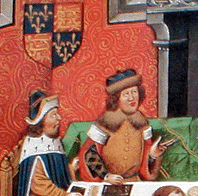 3] Catherine Swynford married 1396, his long standing
mistress but importantly the succeeding line led to links with the Tudor
line, a line often over-emphasised in popular history because of the
economic and social advances achieved during the reigns of King Henry VIII and
Queen Elizabeth I. Catherine was born in 1350 and died 1403. She became the
Duchess of Lancaster at her marriage. Her first husband was Sir Hugh
Swynford, who was a retinue member of John of Gaunt. Hugh died in 1372
and she became a governess of his children by his second wife
& John's mistress. She bore John four children who were given the
name Beaufort after one of John's estates, Beaufort Castle in Champagne.
The Beauforts were all legitimised in 1397 under King Richard II by an act of parliament with
the proviso inserted in 1407 that they had no claim to the throne.* Catherine's
maiden name was Roet, a Flemish name, she was the sister to Geoffrey
Chaucer's wife, Philippa Roet who had been one of Queen Philippa's
chamber ladies. John Chaucer, his father had been in attendance on Edward
III in 1338 and this association led to Geoffrey's employment with
the King's Court, when he was engaged as a page in the household of
Duke Lionel & Elizabeth. [Duke of Clarence] In 1359 Geoffrey Chaucer
joined Edward III's army when France was invaded. He was taken prisoner
and Edward III himself had to pay the poet's ransom. In March 1360 Geoffrey
was given his freedom when Edward parted with 16 pounds for this yet
to be celebrated author's liberty. In 1367 Chaucer was given a life pension
for being a valet of the King's household, Lionel died in1368 so Chaucer
transferred his services to John of Gaunt. * However,
later the Beaufort's gained entry into the royal successsion when John
of Gaunt's great-granddaughter, Margaret Beaufort, married Edmund Tudor
[Tewdor] whose son became Henry VII, thus beginning the ruling Tudor dynasty.
3] Catherine Swynford married 1396, his long standing
mistress but importantly the succeeding line led to links with the Tudor
line, a line often over-emphasised in popular history because of the
economic and social advances achieved during the reigns of King Henry VIII and
Queen Elizabeth I. Catherine was born in 1350 and died 1403. She became the
Duchess of Lancaster at her marriage. Her first husband was Sir Hugh
Swynford, who was a retinue member of John of Gaunt. Hugh died in 1372
and she became a governess of his children by his second wife
& John's mistress. She bore John four children who were given the
name Beaufort after one of John's estates, Beaufort Castle in Champagne.
The Beauforts were all legitimised in 1397 under King Richard II by an act of parliament with
the proviso inserted in 1407 that they had no claim to the throne.* Catherine's
maiden name was Roet, a Flemish name, she was the sister to Geoffrey
Chaucer's wife, Philippa Roet who had been one of Queen Philippa's
chamber ladies. John Chaucer, his father had been in attendance on Edward
III in 1338 and this association led to Geoffrey's employment with
the King's Court, when he was engaged as a page in the household of
Duke Lionel & Elizabeth. [Duke of Clarence] In 1359 Geoffrey Chaucer
joined Edward III's army when France was invaded. He was taken prisoner
and Edward III himself had to pay the poet's ransom. In March 1360 Geoffrey
was given his freedom when Edward parted with 16 pounds for this yet
to be celebrated author's liberty. In 1367 Chaucer was given a life pension
for being a valet of the King's household, Lionel died in1368 so Chaucer
transferred his services to John of Gaunt. * However,
later the Beaufort's gained entry into the royal successsion when John
of Gaunt's great-granddaughter, Margaret Beaufort, married Edmund Tudor
[Tewdor] whose son became Henry VII, thus beginning the ruling Tudor dynasty.
Tomb of Katherine Swynford
and her daughter Joan 'Beaufort' in Lincoln Cathedral.
Note that
the coat of arms were removed by Parliamentarians in 1644 during
the Civil War
John Montague,
a contemporary in the King's Court was part of the literati of the
Court of Edward III and Richard II. John is believed to be the writer
of some of the early "Robin Hood"
ballads. Interestingly there is a township named after Gaunt, "John O' Gaunts"
about five miles north of Wakefield not far from the township of "Robin
Hood" near Rothwell a part of the honour of Pontefract.
John of Gaunt died in 1399 and his possessions were seized
by Richard II. Richard was to soon suffer the same fate after his return
from a campaign in Ireland when Henry Bolingbroke [later Henry IV]
returned from exile in France and had Richard incarcerated in Gaunt's
old stronghold, Pontefract Castle [possibly in the Gascoigne Tower].
Here Richard is traditionally thought to have died from starvation, a
death which would leave little trace of any nefarious deed.
|
|
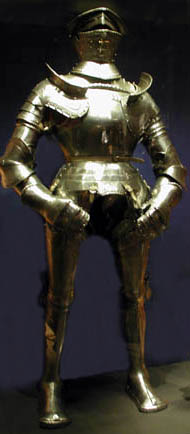
| John of Gaunt's armour in the
White Tower, London |
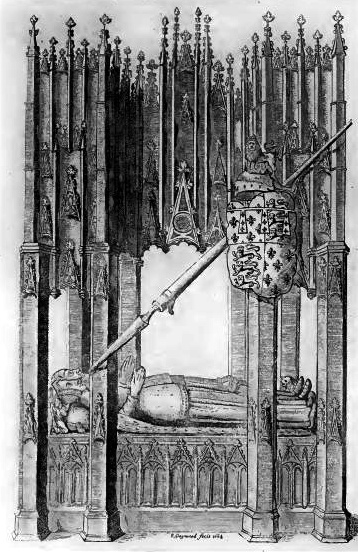
The tomb of John of Gaunt and Blanche Duchess
of Lancaster in Old St. Paul's Cathedral. Destroyed in the Great Fire of London,
1666. |
The ownership of the Duchy of Lancaster made Gaunt the overlord of the knight's fees of the honour of Pontefract. Gaunt presented to the church at Elland as did his wife, the Spanish Constanza of Castile and her brother Ferdinando. As further evidence of Gaunt's overlordship in the honour, his heraldic arms are found in the east window of St. Mary's Chapel. Elland 'became the home of the main branch of the Savile family, who became lords of the manor of Elland through their alliance with the Eland heiress, was at Thornhill, of which church Robert Frost, chancellor to Prince Arthur, was the rector, a circumstance which would readily account for the arms of this Prince being found at Elland.6 Among the families of the honour were those of Midgley in William de Miggeley [b. ~ 1280, d.1336] and his descendants. As a Parliamentary knight and Yorkshire Court Lawyer, William had probably invested in the wool trade such that his descendants were well invested at Halifax, Midgley near Halifax, Shelf, Thornton, Stanley and Midgley near Wakefield.
 |
| A painting of Elland Church about 1840. |
 |
| The interior of the so-called 'John of Gaunt's Cellar' under the great hall of Leicester Castle. This may have been constructed after his death. |
 |
| Later external entrance to 'John of Gaunt's Cellar' or 'Old Dungeon - John Flower 1825 |
 |
 |
| Original entrance to the 'Old Dungeon- restored. | Later entrance from inside the 'Old Dungeon' 1859 - James Thompson |
 PREVIOUS
See: Geoffrey
Chaucer
PREVIOUS
See: Geoffrey
Chaucer
2. Johnson, Paul, The Life and Times of Edward III,
Weidenfeld & Nicolson, London, 1973.
3. Bedingfield, Henry, Heraldry, Bison Books,
1973.
4. Speed, John, The Counties of Britain, 1610.
5. Weir, Alison. Britains Royal Families, The Complete Genealogy. Pimlico, 2002
6. Crossley, E.W., Y.A.J., vol. 25, (1920), p. 444.
